
The use of AVS in production of various construction materials, such as nano-modified concrete, finely dispersed cement, extra-strong silex bricks etc, is very promising.
The vortex layer device, or the AVS-100, has been tested in various industrial facilities. Practice shows that AVS efficiently replaces such devices as ball, vibration, hammer mills, various pulverizers and dispersers. AVS units are used as reactors, mixers etc.
Application in claydite production
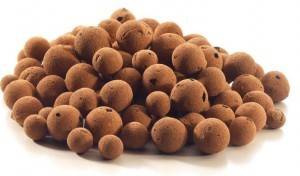
Claydite.
 In the process of claydite production clay is homogenized and pulverized in mixers, roll mills etc. However, these devices do not ensure quality pulverization,hence the low strength of claydite. Due to lack of pulverization and homogenization even 3% of carbon inclusions in well foamed low-fusible clay makes it useless the resulting claydite loses strength or disintegrates in storage due to CaO hydration. Our solution to the problem is the Vortex Layer Deivce.
Oversanded clay with free SiO2 content up to 10-30% are also hardly usable for claydite production. All of these problems are largely solved by processing the raw material in the vortex layer. Pulverization and homogenization of furnace-charge for general purpose and specialized claydite production in AVS resulted in significant volume weight reduction and strength increase (see Table below)
Table 1
Results of pulverization and homogenization of furnace-charge in AVS for claydite production
| Exp No | Raw material and AVS processing duration | Claydite mechanical properties | |||||
| Furnace-charge processing in AVS | Furnace-charge mixed without AVS | ||||||
| Volume weight, γ, g/cm3 | Shear strength σs*10-5, Pa | Strength to weight ratio | Volume weight, γ, g/cm3 | Shear strength τs*10-5, Pa | Strength to weight ratio | ||
| 1 | Clay with 26% free SiO2 (30 second slip processing) | 0,24 | 2,25 | 10,3 | 0,38 | 1,60 | 5,1 |
| 2 | Same with 41% free SiO2(30 second slip processing) | 0,34 | 2,45 | 7,8 | 0,84 | 3,24 | 4,1 |
| 3 | Monotermit (7 minute dry processing) | 0,85 | 29,4 | 36 | 1,6 | 9,81 | 6,5 |
| 4 | Clay 50%, carbon cinder 50% (7 minute dry processing) | 0,57 | 10,7 | 18 | 0,58 | 1,32 | 8,4 |
| 5 | Same with powdering the raw material with kaolin (7 minute dry processing) | 0,74 | 27,9 | 32,0 | |||
Processing of clay slurry from clay containing up to 40% silica dioxide caused double reduction of claydite weight volume with simultaneous strength increase (strength to weight ratio of AVS-processed claydite is almost twice that of regular furnace charge). The sharp improvement of claydite properties, is, obviously, the activation of quartz sand due to formation of active centers – free radicals, formed because of the breaking of siloxane linkage Si—O similar to dispersion of SiO2 in disintegrators at high rotor RPM.
Activation of SiO2 causes silica dioxide to actively participate in silicate and glass formation. After burning of claydite, there are no large SiO2 particles (stress points) in the granules. Presence of SiO2 in glass increases strength and heat resistance.
Dry processing of the raw material in the vortex layer is quite efficient. For instance, the monothermite processing resulted in light weight fire resistance filler with half the specific weight and three times the strength of control samples (Experiment 3, Table 1). This was achieved by dry processing of multi-component furnace-charge with up to 50% of thermal plant cinder in the vortex layer (experiments 4 and 5).
The examples demonstrate that using the AVS is quite promising for production of claydite from oversanded material with high carbon content, for production of claydite with increased strength and thermal resistance, high quality fillers from furnace-charge with up to 50% waste, such as carbon cinder.
Production of foam concrete
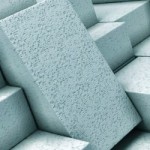 Foam concrete is produced by setting the mixture of binder, water and siliceous aggregate, foamed with a foaming agent. The most often used foaming agent is aluminum powder, which emits hydrogen in the reaction of water solution of sodium hydroxide.
It is known that the quality of foamed concrete increases with the decrease of pore size and increase of uniformity. To achieve this, the aluminum powder must be uniformly dispersed in the mix. Besides, the structure of foamed concrete is determined by such factor as presence of active CaO in the mix.
Usually, foaming agent preparation involves only the removal of paraffin film from the particles of aluminum by mixing them with water and surfactants and then blending the suspension with the mix. Due to the low efficiency of the mixing devices, the paraffin film is very difficult to remove. Besides, the particles of aluminum coagulate, which causes concentrated gas emission in the mix, cavities and cracks. Due to insufficient gas emission in production of gas silicate, the mix must be combined with up to 25% lime. The need for additional lime is also dictated by the requirement to obtain, by hydration setting, sufficient strength of the concrete to keep it foamed. Using AVS in preparation of the aluminum suspensions in production of gas silicate allows to completely eliminate coagulation of aluminum particles, increasing their activity, emission of gas and homogeneity. Some comparative data on physical and chemical properties of gas silicate, produced with aluminum suspension prepared by various methods, is shown in table 2.
Table 2
Physical and mechanical properties of gas silicate produced using aluminum suspension made using different methods
| Exp No | Suspension preparation conditions | AVS-100 processing rate, l/hour | Mechanical qualities of the gas silicate | |||||
| AVS processing | Mixer processing | |||||||
| Specific weight, γ, g/cm3 | Shear strength σs*10-5, Pa | Strength to weight ratio | Specific weight, γ, g/cm3 | Shear strength τс*10-5, Pa | Strength to weight ratio | |||
| 1 | Aluminum powder — 100% of calculated amount | 120 | 385
377 414 |
18,7
10,3 11,8 |
2,56
1,47 1,41 |
396
419 438 |
15,2
79,5 10,8 |
2,03 0,92 1,14 |
| 2 | Same – 90% of calculated amount | 950 | 386
427 375 |
14,5
15,2 12,3 |
1,85
1,70 1,80 |
437
— — |
14,1
— — |
1,51 — — |
The table shows that using AVS processed aluminum suspension resulted in gas silicate with strength 10-30% higher and strength to weight ration 20-60% higher than those of the control sample (table 2, experiment1).
Using AVS allowed to reduce foaming agent consumption by 10%, lime consumption by 2%, without making the product heavier. On the contrary, the specific weight was reduced, while strength to weight ratio increased. Apparently, the quality of foamed concrete can be increased by processing the lime-sand or cement-sand mix in the vortex layer to activate SiO2 similar to the process if claydite production.
Production of silex brick
Silex brick
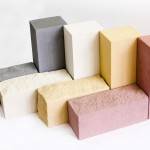 The raw material for silex brick production are quartz sand (92-95% dry mix) and lime (5-8%). The strength of the brick are directely correlated to the activation of SiO2 and uniform distribution of the components. This makes the AVS very promising for processing of the dry mix for component activation. To explore this, lime and sand mix was sifted through the vortex layer of the AVS-100 unit. It is interesting that such brief processing (particles of the mix passed through the vortex layer in fractions of a second) did not cause pulverization of sand and lime. The degree of activation can be judged by the change of the mechanical properties of the brick made from this mix.
| AVS processing conditions | Compression strength σs*10-5, Pa |
| No processing | 91,2 |
| One sifting through the layer | 239,5 |
| Two siftings | 324,5 |
| Three siftings | 328,1 |
As the data shows, brief processing of the mix increases the strength of silex brick by 3.5 times.
Apparently, similar processing of sand/lime, lime/cinder and lime/silica mixes will lead to similarly significant improvement of mechanical properties of silicate concretes, widely used in construction.